November 25, 2011

Metal Detector

It's a simple metal detector design that has the quite good characteristics. the principle of operation which one differs from the classic schemes (BFO, transmit-receive known as "two-boxes" metal detector, inductive).

The dynamic mode is used to find targets in interference environment. There is known from theory of signal filtration that if signal shape is determined we can construct optimal filter - the best one for extracting the signal with maximum signal/noise ratio. This filter is known as optimal matched filter. In our device we realized digital optimal matched filter as part of microcontroller software. The filter parameters are optimized for effective ferro- and non-ferro targets detection on 0.5-1.0 m/s velocity of sensor.

Features of the Metal Detector:
Power supply .............................4.5-6V;
DC consumption .......................15 mA;
Indication ...................................sound + 8 LEDs;
Modes ........................................static or dynamic;
Discrimination.............................ferro/non-ferro.


Metal Detector Schematic


Switches controlled (versions V1.9 and V2.0 of firmware):
S0: reset device;
S1: reserved;
S2: on - threshold high, off - threshold low;
S3: measuring time on - 30ms, off - 120ms;
S4: self tuning on/off (in dynamic mode only);
S5: mode on - static, off - dynamic.


Metal detector PCB Layout


Metal Detector Coil Design

Approx. 100 curls 200 mm in diameter. Copper wire in isolation 0,35 mm diameter


Mobile phone call indicator

Purpose
This circuit can be used to escape from the nuisance of mobile phone rings when you are at home. This circuit will give a visual indication if placed near a mobile phone even if the ringer is deactivated. This circuit was designed to detect when a call is incoming in a cellular phone (even when the calling tone of the device is switched-off) by means of a flashing LED.

The device must be placed a few centimeters from the cellular phone, so its sensor coil L1 can detect the field emitted by the phone receiver during an incoming call.

Device operation

When a call is coming to the mobile phone, the transmitter inside it becomes activated. The  frequency of the transmitter is around 900MHz.The  coil L1 picks up these oscillations by induction and feds it to the base of Q1. This makes the transistor Q1 activated.Since the Collector of Q1 is connected to the pin 2 of IC1 (NE555) , the IC1 is triggered to make the LED connected at  its output pin (pin 3) to blink. The blinking of the LED is the indication of incoming call.

The signal detected by the sensor coil is amplified by transistor Q1 and drives the monostable input pin of IC1. The IC's output voltage is doubled by C2 & D2 in order to drive the high-efficiency ultra-bright LED at a suitable peak-voltage.

Note:

  • Stand-by current drawing is less than 200µA, therefore a power on/off switch is unnecessary.
  • Sensitivity of this circuit depends on the sensor coil type.
  • L1 can be made by winding 130 to 150 turns of 0.2 mm. enameled wire on a 5 cm. diameter former (e.g. a can). Remove the coil from the former and wind it with insulating tape, thus obtaining a stand-alone coil.
  • A commercial 10mH miniature inductor, usually sold in the form of a tiny rectangular plastic box, can be used satisfactorily but with lower sensitivity.
  • IC1 must be a CMos type: only these devices can safely operate at 1.5V supply or less.
  • Any Schottky-barrier type diode can be used in place of the 1N5819: the BAT46 type is a very good choice.

November 19, 2011

HOW SOLAR CELLS WORK

SOLAR CELLS, How They Work


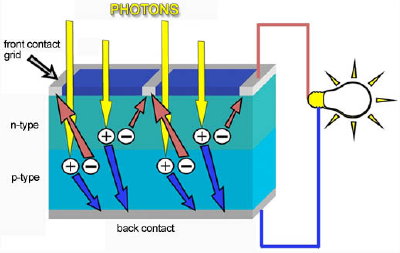
The solar cell offers a limitless and environmentally friendly source of electricity. The solar cell, is able to create electricity directly from photons. A photon can be thought of as a packet of light and the amount of energy in a photon is proportional to the wavelength of light.


Solar Cell Structure:


A. Encapsulate - The encapsulate, made of glass or other clear material such clear plastic, seals the cell from the external environment.
 
B. Contact Grid- The contact grid is made of a good conductor, such as a metal, and it serves as a collector of electrons.
 
C. The Anti reflective Coating (AR Coating)- Through a combination of a favorable refractive index, and thickness, this layer serves to guide light into the solar cell. Without this layer, much of the light would simply bounce off the surface.
 
D. N-Type Silicon - N-type silicon is created by doping (contaminating) the Si with compounds that contain one more valence electrons* than Si does, such as with either Phosphorus or Arsenic. Since only four electrons are required to bond with the four adjacent silicon atoms, the fifth valence electron is available for conduction.
 
E. P-Type Silicon- P-type silicon is created by doping with compounds containing one less valence electrons* than Si does, such as with Boron. When silicon (four valence electrons) is doped with atoms that have one less valence electrons (three valence electrons), only three electrons are available for bonding with four adjacent silicon atoms, therefore an incomplete bond (hole) exists which can attract an electron from a nearby atom. Filling one hole creates another hole in a different Si atom. This movement of holes is available for conduction.
 
F. Back Contact - The back contact, made out of a metal, covers the entire back surface of the solar cell and acts as a conductor.
 
*[ A valence electron is an electron found in the outermost electron shell. An element containing more valence electrons will try to donate valence electrons to an element containing fewer valence electrons.] *

A photon's  path through the solar cell

Once the photon passes the anti reflective layer, it will either hit the silicon surface of the solar cell or the contact grid metallization. The metallization, being opaque, lowers the number of photons reaching the Si surface. The contact grid must be large enough to collect electrons yet cover as little of the solar cell's surface, allowing more photons to penetrate.


A Photon causes the Photoelectric Effect*.

The photon's energy transfers to the valence electron of an atom in the n-type Si layer. That energy allows the valence electron to escape its orbit leaving behind a hole. In the n-type silicon layer, the free electrons are called majority carriers whereas the holes are called minority carriers. As the term "carrier" implies, both are able to move throughout the silicon layer of the solar cell, and so are said to be mobile. Inversely, in the p-type silicon layer, electrons are termed minority carriers and holes are termed majority carriers, and of course are also mobile.
 
*[ The photoelectric effect is simply defined as an experimentally measurable effect where a metal emits electrons when hit by photons..] *


The p-n junction.

The region in the solar cell where the n-type and p-type Si layers meet is called the p-n junction. As you may have already guessed, the p-type silicon layer contains more positive charges, called holes, and the n-type silicon layer contains more negative charges, or electrons. When p-type and n-type materials are placed in contact with each other, current will flow readily in one direction (forward biased) but not in the other (reverse biased).

An interesting interaction occurs at the p-n junction of a darkened solar cell. Extra valence electrons in the n-type layer move into the p-type layer filling the holes in the p-type layer forming what is called a depletion zone. The depletion zone does not contain any mobile positive or negative charges. Moreover, this zone keeps other charges from the p and n-type layers from moving across it.

So, to recap, a region depleted of carriers is left around the junction, and a small electrical imbalance exists inside the solar cell. This electrical imbalance amounts to about 0.6 to 0.7 volts. So due to the p-n junction, a built in electric field is always present across the solar cell.

P = V × I

When photons hit the solar cell, freed electrons (-) attempt to unite with holes on the p-type layer. The p-n junction, a one-way road, only allows the electrons to move in one direction. If we provide an external conductive path, electrons will flow through this path to their original (p-type) side to unite with holes.

The electron flow provides the current ( I ), and the cell's electric field causes a voltage ( V ). With both current and voltage, we have power ( P ), which is just the product of the two. Therefore, when an external load (such as an electric bulb) is connected between the front and back contacts, electricity flows in the cell, working for us along the way.
 

DOOR BELL FOR DEAF CLICK HERE

Electronics is the study and use of electrical that operate by controlling the flow of electrons or other electrically charged particles in devices such as thermionic valves. and semiconductors. The pure study of such devices is considered as a branch of physics, while the design and construction electronic circuits to solve practical problems is called electronic engineering.

Popular article